
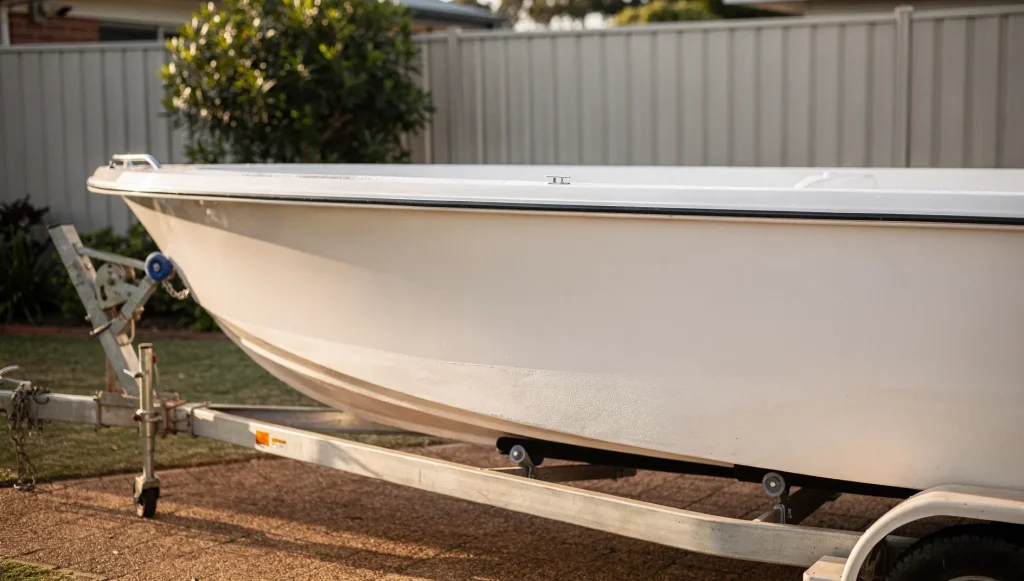
Run your hand across a hull that used to gleam, and if your palm comes away dusted with a dull, powdery film, you have met oxidation first-hand. Understanding why boat hulls turn chalky starts with knowing what that residue is and what caused it. Chalkiness is one of the most common surface problems addressed through exterior detailing in Perth, WA, and the good news is that in most cases the shine beneath can be brought back.
This is a gradual, surface-driven problem rather than a sudden one. Unlike the scuffs and contact marks that come from docking and fenders, chalkiness builds slowly across the whole hull as sun and salt air wear down the outer finish.
What Chalkiness Actually Is
The glossy outer surface of a fibreglass boat is gelcoat, a tinted resin layer applied over the fibreglass during manufacture. It is this layer, not the fibreglass itself, that gives a hull its colour and shine. Gelcoat is designed to be the sacrificial protective skin that takes the brunt of the environment.
Oxidation is the breakdown of that outer resin. When the surface is exposed to ultraviolet light and air over time, the resin at the very top degrades. The smooth, reflective film breaks down into a fine, dull residue sitting on the surface. That powder you feel on your hand is the gelcoat’s own protective layer, broken down into loose particles.
A glossy finish reflects light evenly because the surface is smooth and intact. A chalky finish scatters light because the surface has become rough and porous at a microscopic level. That is why an oxidised hull looks faded and flat even when it is clean.
Why Perth Conditions Accelerate the Problem
Oxidation happens everywhere, but it does not happen at the same pace everywhere. Two factors drive it hard in Western Australia: intense UV exposure and salt air.
Perth receives strong, sustained sunlight across much of the year. Ultraviolet radiation is the main engine of gelcoat breakdown, and a boat that spends its days on a mooring, a trailer or a hardstand takes a steady dose of it. The more direct sun a hull sees, the faster the resin surface degrades.
Salt adds a second mechanism. Marine air carries fine salt that settles on the surface, draws moisture and keeps the finish working harder. On hulls kept near the coast or used regularly in the ocean, the combination of UV and salt wears the protective layer down faster than a milder, inland or freshwater setting would.
The Life Cycle From Glossy to Chalky
A new or freshly detailed hull starts glossy because the gelcoat surface is smooth and sealed. From there, without maintenance, the finish follows a fairly predictable path.
- The gloss begins to flatten slightly as the very top of the resin starts to break down.
- The colour starts to look faded and dull, losing its depth.
- A light powder appears on the surface and transfers to your hand.
- Left longer, the chalkiness deepens and the protective layer thins further.
Each stage represents more of the protective layer being lost. Because gelcoat has a finite thickness, the goal of routine care is to slow this cycle so the layer lasts as long as possible rather than wearing away prematurely.
How to Assess Oxidation Severity
Not all chalkiness is equal, and reading the severity helps set expectations for restoration. In broad terms, oxidation falls into three levels.
- Light oxidation shows as a slight loss of gloss and a faint film. The surface still has colour and usually responds well to a gentle polish.
- Moderate oxidation looks visibly dull and faded, with a clear powdery residue. It typically needs a more thorough cutting step to clear the degraded layer.
- Heavy oxidation appears strongly faded and chalky across large areas, with the colour looking washed out. More of the protective layer has been lost, so restoration is more involved.
Severity reflects how deep the breakdown has gone and how much sound gelcoat remains beneath. A simple test is to clean a small area and check whether the shine returns with light work or whether more effort is needed.
The Restoration Pathway
Bringing a chalky hull back is about removing the oxidised layer to reveal the sound gelcoat underneath. Oxidation sits on the surface, so clearing that thin degraded film exposes intact resin that still holds colour and gloss.
This is usually done with machine polishing, often starting with a compound to cut through heavier oxidation and then refining with finer polishes to restore clarity. The process removes the dull residue in controlled stages rather than all at once, which protects the gelcoat that remains. For heavier cases, more cutting is needed; for lighter cases, a single refining pass may be enough. The same care applies here as with any contact marks, where keeping the finish free of avoidable surface marks helps the overall result last.
Building In Lasting Protection
Restoration clears the oxidation, but the hull will begin to re-oxidise the moment it faces sun and salt again unless it is protected. The point of adding a protective step is to put a fresh barrier over the restored gelcoat.
Protective coatings help shield the surface from UV and reduce how quickly the next round of breakdown sets in. Routine care supports this: regular washing to lift salt and grime, and periodic reapplication of protection before the finish starts to dull again. Consistent maintenance keeps the protective layer working and slows the whole oxidation cycle.
Oxidation is a whole-surface issue, driven evenly across the hull by sun and air. But some parts of a hull suffer from a different kind of discolouration altogether, one caused not by what is above the water but by prolonged contact with the water itself, leaving stubborn marks that gather along the waterline. That is a separate problem with its own causes, and worth understanding on its own terms.