
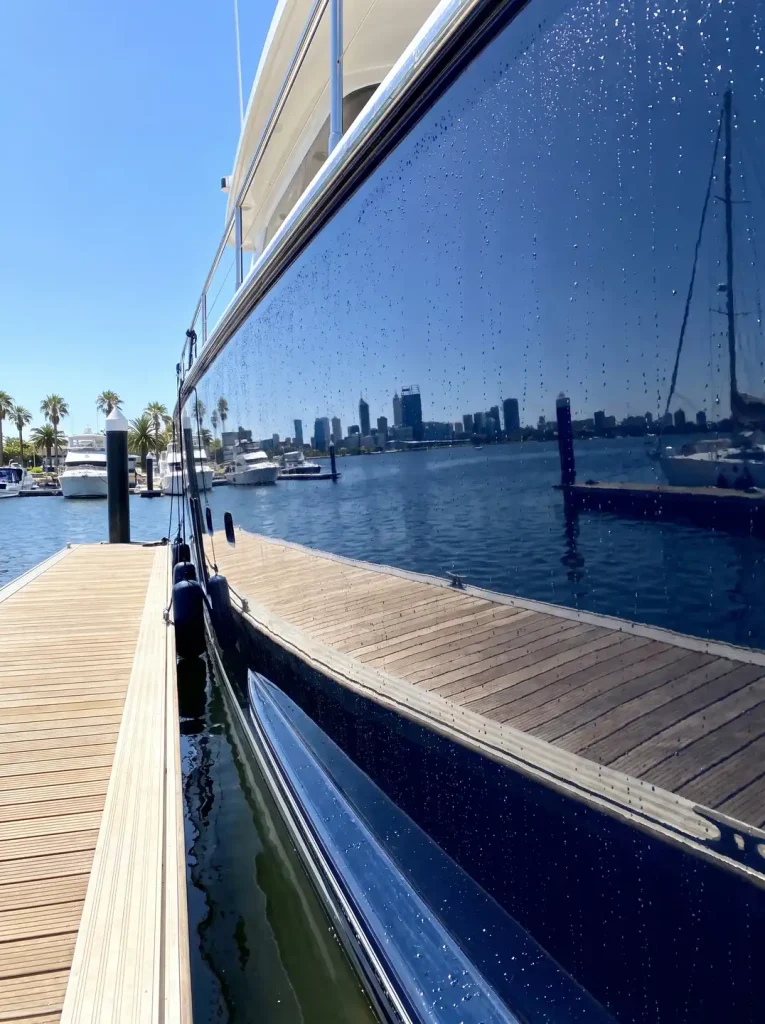
There is a principle that experienced detailers return to again and again: the result of a ceramic coating is determined before a single drop of product touches the surface. This is why anyone serious about boat surface ceramic coating invests as much in the preparation as in the coating itself. Skipping or rushing the prep phase does not save time — it guarantees a compromised result, regardless of the quality of the product applied.
This article walks through the physical preparation sequence that takes place before any ceramic coating work begins on a marine vessel. Each stage has a specific purpose, and each one builds on the last.
01 – Why Surface Prep Is the Foundation of Coating Performance
Ceramic coatings bond to a surface through a chemical process. For that bond to form correctly, the substrate needs to be genuinely clean — not just visually clean, but free of contaminants at a microscopic level. Salt residue, wax layers, silicone from old products, oxidation, and biological fouling all interfere with adhesion. They sit between the coating and the gelcoat or paint, preventing the chemical bond from forming fully.
When a ceramic coating is applied over a contaminated surface, it does not bond evenly. Some areas may adhere well. Others will not. The result is patchy protection, premature failure in high-stress areas, and a coating that may begin lifting or hazing within months rather than lasting years. No amount of product quality can compensate for poor surface preparation.
This is especially relevant in Perth’s marine environment. Boats operating in Swan River, Cockburn Sound, or out through Fremantle are exposed to a combination of salt, UV, biological growth, and pollution that creates layered contamination on hull and topside surfaces. That contamination has to be fully removed before any coating work begins.
02 – The Wash and Rinse Stage
The preparation process begins with a thorough wash. This is not a routine rinse-down at the boat ramp. A pre-detail wash on a marine vessel is a systematic process designed to remove the outermost layers of contamination — salt deposits, algae, bird fouling, grime, and any loose biological material from the waterline and hull.
Marine vessels carry contamination that cars do not. Saltwater creates mineral deposits that bond to surfaces over time. Algae and biofilm establish themselves along the waterline. Diesel exhaust residue settles on topsides. Each of these requires specific attention and, in some cases, targeted cleaning agents suited to the type of fouling present.
The wash stage covers the entire vessel — hull, deck, topsides, and any areas that will receive coating. A proper rinse follows to ensure no cleaning residue is left on the surface. At this point, the boat looks clean. But looking clean and being clean enough for ceramic coating are very different things.
03 – Decontamination: Beyond What Soap Can Remove
Once the surface is washed, decontamination addresses what the wash cannot reach. Marina environments expose boats to iron fallout from nearby metalwork and machinery, mineral deposits from hard water and salt, and embedded particles that have worked their way into the surface over time. These contaminants are not removed by washing alone.
Clay bar treatment is one of the primary tools used at this stage. A detailing clay bar is worked across the surface with a lubricant, physically lifting embedded particles that are bonded to the gelcoat or paint. When the clay bar drags slightly and then begins to glide freely, it indicates the surface has reached a much cleaner baseline.
Chemical decontamination products may also be used alongside or instead of clay bar treatment, depending on the type and level of contamination present. Iron removers, for example, react visibly with ferrous particles on the surface and allow them to be rinsed away. Together, these steps bring the surface to a level of cleanliness that a wash alone cannot achieve — one that is genuinely suitable for coating adhesion.
04 – Surface Inspection and Assessment
Once the surface is clean and decontaminated, a thorough inspection takes place. This is a critical stage, and it requires good lighting. Detailers use directed light sources — often handheld inspection lights or work lights positioned at low angles — to reveal what is actually on the surface.
What they are looking for includes oxidation in the gelcoat, swirl marks from previous washing or polishing, surface scratches, and any other defects that exist in or on the surface. This matters for one specific reason: a ceramic coating does not hide defects. It locks them in. Any imperfection present on the surface at the moment of application will remain visible — and in some cases more visible — once the coating is cured.
The inspection stage is where a decision gets made about what needs to happen before the coating can go on. Some surfaces are in good enough condition to proceed. Others have oxidation or marring that needs to be addressed first. This is the point where the preparation process and the correction process meet — but the correction work itself is a separate discipline with its own methods and considerations.
05 – Final Surface Wipe-Down Before Application
The last step before any coating product is introduced is a panel wipe-down using isopropyl alcohol (IPA). This step removes any remaining oils, polish residues, fingerprints, or light contamination that may have settled on the surface during the inspection and correction stages. It is a reset — bringing the surface to a genuinely bare, oil-free state ready to receive the coating.
IPA wipe-down is done panel by panel, immediately before each section is coated. It is not done once across the whole boat at the start. The reason is straightforward: surfaces can be re-contaminated by contact, dust, or even handling between the wipe and the application. Keeping the sequence tight matters.
Surface temperature is also checked at this stage. Gelcoat and paint that are too hot — from direct sun exposure on a Perth summer day — can cause coating products to flash too quickly during application. Ensuring the surface is within an acceptable temperature range before proceeding is a practical check that experienced detailers make as a matter of routine.
Once the surface is clean, decontaminated, and assessed, the next question is whether any defects need to be corrected first — and understanding why paint correction matters before coating can make the difference between a result that lasts and one that disappoints.