
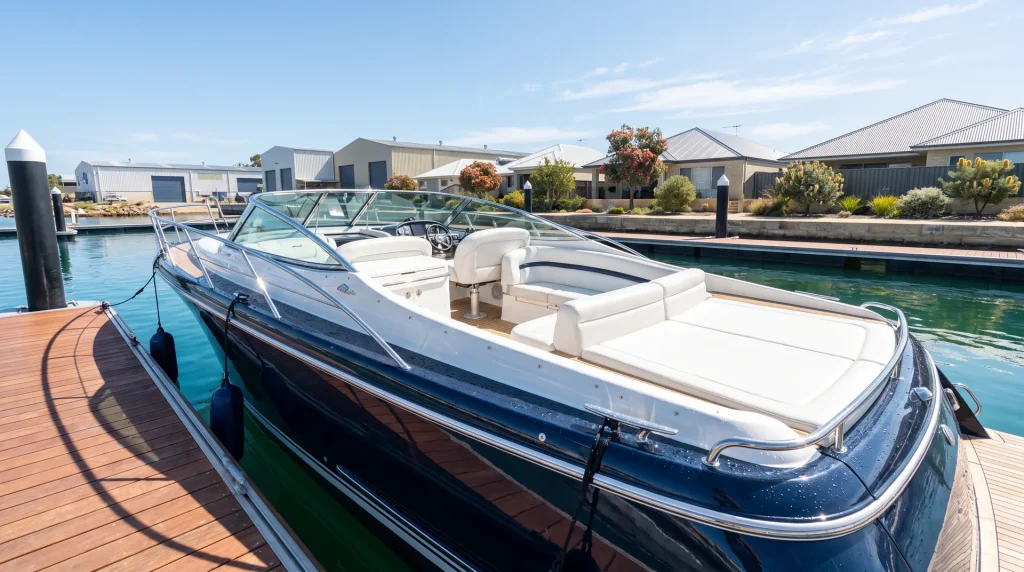
Plenty of Perth owners keep their boats on trailers in the driveway, on hardstands, or in open marina berths with no cover from January to December. It is convenient and often unavoidable. The trade-off is that constant exposure wears a vessel far faster than intermittent, covered use. Regular professional boat detailing becomes the practical foundation for keeping a permanently outdoor-stored boat looking and performing well, because the damage never pauses long enough for neglect to go unnoticed.
The key shift in thinking is this: outdoor year-round storage is not a one-off cleaning problem. It is a management problem. You are not fixing damage once; you are staying ahead of a slow, cumulative process.
Why Permanent Outdoor Storage Is a Different Problem
A boat used seasonally and stored under cover gets long rest periods away from the elements. Surfaces dry out fully, salt is rinsed off, and protective layers hold up for longer. A boat left outside all year gets none of that relief.
Instead, every threat stacks on top of the last. Sun softens and thins protective coatings during the day. Overnight dew keeps salt residue sitting on surfaces. Wind carries dust and grit that settle into every seam. Rain flushes some contaminants away but leaves its own residue behind. Temperature swings between hot afternoons and cool nights make materials expand and contract repeatedly.
None of these are catastrophic on their own. Together, running continuously for months, they accelerate wear in a way that surprises many owners. By the time fading, chalking or staining becomes obvious, the protective layer that should have blocked it has usually been gone for a while.
A Seasonal Exposure Calendar for Perth
Perth’s climate hits an outdoor-stored boat differently through the year, so the protection routine should shift with the seasons rather than stay static.
- Summer: Long, intense sun and high heat are the dominant stress. This is when protective coatings break down fastest and surfaces need the most frequent attention. Coastal boats also cop steady salt-laden air.
- Autumn: Conditions ease slightly, making it an ideal window to reset protection. A thorough clean and fresh coating heading into cooler months carries the boat through with less effort.
- Winter: Rain, damp and reduced drying time take over. Trapped moisture, poor drainage and slow-drying canvas become the main risks rather than sun.
- Spring: Wind-blown pollen, dust and debris pick up, and warming days start reactivating UV stress. A good clean-down prepares surfaces before summer intensity returns.
The lesson is not to detail on a rigid calendar but to expect different threats at different times and adjust accordingly.
Building a Layered Protective Barrier
For an always-exposed boat, protection works best as layers rather than a single treatment. Each layer buys time before the elements reach the surface underneath.
The base layer is consistent washing. Regular, thorough rinsing removes salt, dust and airborne grime before they can bond or abrade. Skipping washes lets contaminants build and shortens the life of everything above.
The next layer is protective coating. A quality wax or polymer sealant sits over the gelcoat and takes the daily hit from sun and salt so the surface below does not. On a covered boat this might last a good while; on an outdoor boat it wears faster and needs renewing more often.
For owners who want a more durable base, ceramic coating options offer a harder, longer-lasting barrier that stands up better to continuous exposure than traditional wax. It does not remove the need for washing, but it extends the interval between more intensive protective work and holds up well against constant weather load.
Material-by-Material Vulnerabilities
Different parts of the boat age differently under continuous exposure, so a whole-of-vessel approach matters.
- Fibreglass and gelcoat: The most exposed large surfaces. Without a maintained protective layer they gradually lose gloss and colour depth, and salt air slowly works on the surface chemistry over time.
- Stainless and aluminium trim: Rails, cleats and fittings show tea-staining and surface corrosion when salt is left to sit. Regular wipe-downs keep them bright.
- Teak and timber: Constant wet-dry cycling and sun weather timber quickly, leaving it grey and dry without periodic care.
- Canvas and upholstery: These take a double hit from sun degradation and trapped moisture. Poor ventilation encourages mildew, while UV weakens fabrics and stitching.
Storage Positioning and Preparation Habits
Small habits between details reduce how much degradation accumulates. How you park and prepare the boat matters more than owners expect.
Position the boat so water drains away rather than pooling in the bilge, lockers or on flat surfaces. Standing water invites staining and mildew. Where possible, orient the vessel to reduce the amount of direct afternoon sun hitting the most vulnerable surfaces.
Ventilation is critical. Enclosed spaces need airflow so interiors and upholstery can dry between wet spells. A boat sealed up tight in winter can develop more moisture problems than one left open to breathe.
Covers are a genuine trade-off. A well-fitted, breathable cover shields surfaces from sun and debris. A poorly fitted or non-breathable one can trap moisture underneath and create its own damp problems. If you use a cover, make sure it allows airflow and does not sit hard against surfaces where it can chafe or hold water.
Establishing a Maintenance Rhythm
A boat that never comes indoors needs more frequent attention than one that is covered or garaged, simply because its protective layers are working harder and wearing out sooner. The exact rhythm depends on how close to the coast the boat sits, how much shade it gets and the season.
Rather than waiting for problems to appear, the aim is a steady cycle: regular washing between professional details, renewed protective coatings before the harshest seasons, and periodic deeper detailing to reset every surface. That predictable rhythm is what keeps a permanently outdoor-stored boat from slipping into a decline that is expensive to reverse.
Continuous exposure also sets the stage for the biological and staining issues that outdoor boats face, from stubborn marine growth and surface staining that take hold on hulls left in the water.