
Many Perth boat owners assume every boat needs the same care routine. In reality, the way you store your vessel is the single biggest variable in how its hull and surfaces deteriorate. Effective boat detailing starts with understanding your storage environment, because a boat sitting in a marina berth and a boat parked on a trailer face entirely different enemies. Match the approach to the reality, and you protect the vessel far more effectively.
Prefer to watch or listen?
Listen onApple Podcasts
How Marina Storage Exposes the Hull
A boat kept in the water at a marina lives in a constant battle below the waterline. Saltwater immersion never stops. The hull sits submerged twenty-four hours a day, every day, which creates conditions trailored boats simply never experience.
The most visible problem is waterline staining. A grimy tide line forms where the hull meets the water, picking up oils, organic matter and discolouration from the marina itself. Below that line, slime builds quickly. Soft fouling, algae and marine growth take hold on any surface that stays wet, and Perth’s warmer months accelerate this process noticeably.
Marine growth is the long-term concern. Barnacles, weed and harder organisms attach to the hull bottom and underwater fittings. Left unchecked, this growth affects performance and adds drag. For berthed boats, the underwater portions of the hull demand the most attention.
How Trailored Storage Creates Different Problems
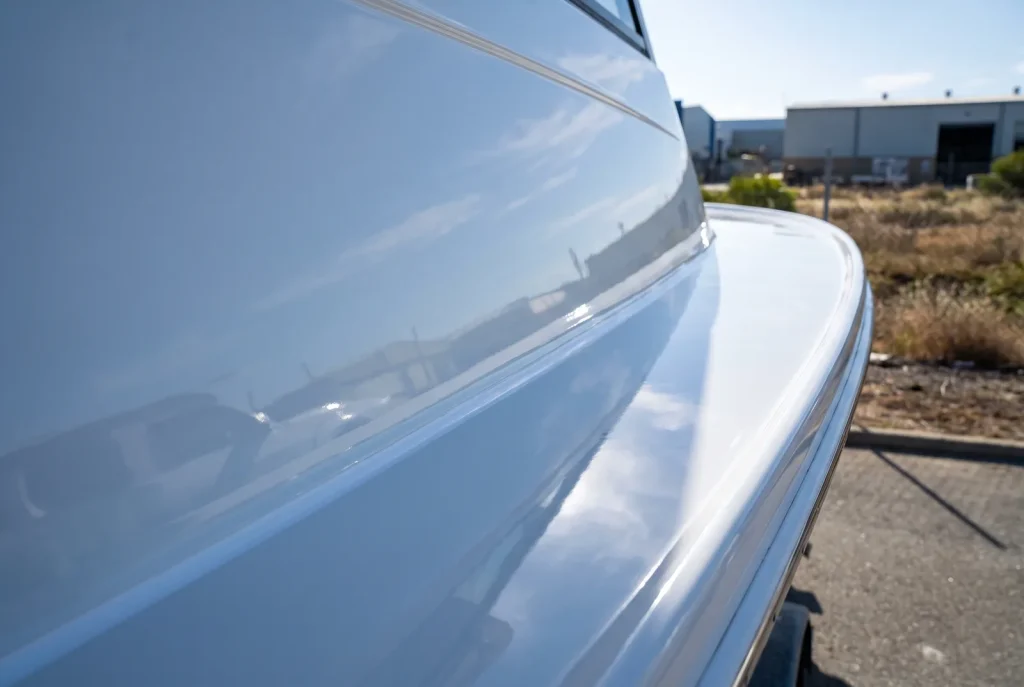
A trailored boat lives out of the water, usually exposed to the open air between outings. Its biggest enemy is the sun. In Perth, prolonged UV exposure during storage breaks down gelcoat over time, causing fading, chalkiness and oxidation on any surface left uncovered.
Road grime is another trailored-only issue. Towing a boat down the freeway coats it in dust, exhaust residue and bitumen flecks. The trailer itself causes wear too. Trailer rash, the scuffing and scratching where the hull contacts rollers, bunks and guides, is a familiar sight on trailored vessels.
Then there is launch-ramp contact. Reversing down a ramp and floating the boat off introduces a fresh round of grit, mud and ramp scum at the waterline each time. Unlike a marina boat, this happens intermittently rather than constantly.
Surface-by-Surface Priorities
The difference in storage shifts where your attention should go. For marina boats, the gelcoat below the waterline and the hull bottom are the priority zones. These areas take the brunt of immersion, staining and growth, so they need regular, focused care.
For trailored boats, the priority flips upward. Topsides, decks and fittings see the most sun and road exposure. In Perth’s harsh climate, the surfaces facing the sky degrade fastest, so the upper hull, deck and exposed hardware become the focus.
This means two boats of identical make can need very different treatment plans purely because of where they spend their downtime.
Salt Air Affects Both, But Differently
Salt is unavoidable on the WA coast, yet it works on each boat type in its own way. A berthed boat sits in continuous contact with saltwater and salt-laden air. The exposure is relentless and consistent, so salt deposits build steadily across hull and fittings.
A trailored boat experiences wet-dry cycling instead. After each outing, salt water dries onto surfaces, leaving crystallised deposits that draw moisture and accelerate corrosion at fittings, fasteners and trim. The harm comes in pulses, tied to how often the boat goes out, rather than as a constant siege.
Both situations call for thorough salt removal, but the timing and focus differ. Berthed boats need ongoing management, while trailored boats benefit most from prompt attention after they come off the water.
Matching Coatings and Treatment Frequency
Protective treatments should suit the storage type. Marina boats benefit from protection that addresses constant immersion and growth on the underwater hull, paired with care for the waterline zone that stains so readily.
Trailored boats, by contrast, gain the most from protection that shields exposed surfaces from UV and helps grime release easily after towing. The treatment frequency follows the exposure pattern: continuous threats often warrant more regular intervention, while intermittent-use boats can be managed around their outing schedule.
Logistics of Detailing Each Type
The practical side differs too. An in-water boat is usually detailed at its marina berth, where access to the hull above the waterline and the topsides is straightforward, while underwater work has its own considerations.
A trailored boat is often detailed at home or near the ramp, where the entire hull is accessible while it sits high and dry on the trailer. This open access makes it easier to reach the hull bottom and the surfaces a berthed boat keeps submerged.
Whichever way you store your vessel, recognising the warning signs early keeps small problems from becoming big ones. The next topic worth exploring is Signs Your Boat Needs Professional Detailing.