
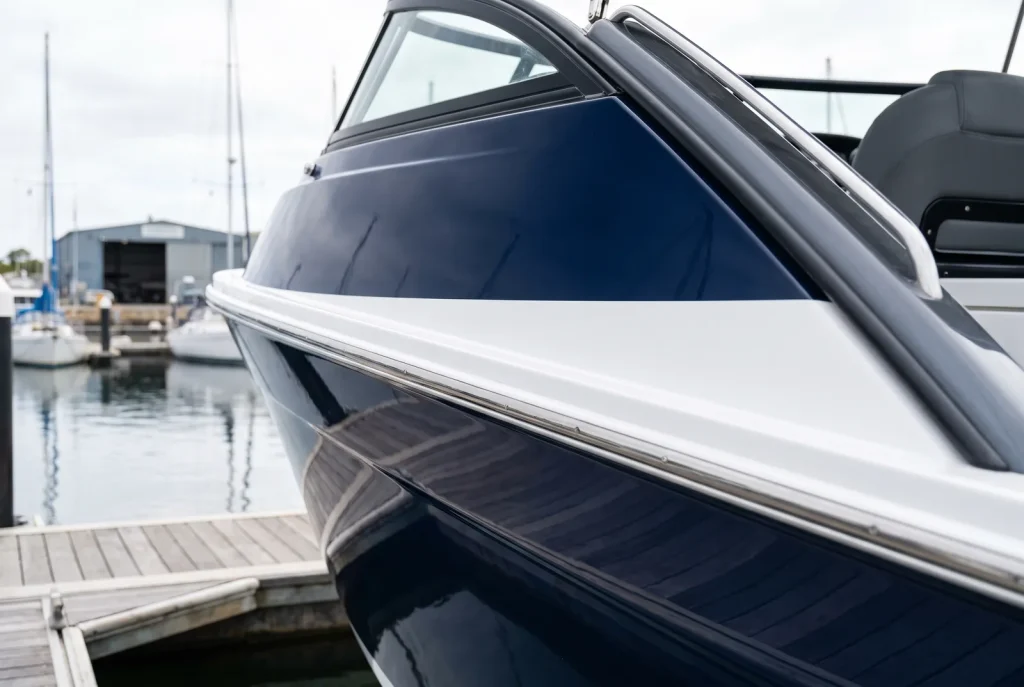
A boat is a depreciating asset. From the moment you take ownership, its value drifts downward – but the rate of that drift is far from fixed. Condition is the single biggest lever an owner actually controls when it comes time to sell, and condition is built (or lost) slowly, over years of care or neglect. Regular professional boat detailing in Perth, WA is one of the most reliable ways to slow that depreciation and protect what the vessel is worth down the track.
This is the long-arc argument: not how to polish a boat for a listing photo, but how sustained care keeps money in the hull over an entire ownership period.
Prefer to watch or listen?
Listen onApple Podcasts
How Buyers Read Condition and Price It In
Buyers rarely have technical access to a hull’s history. They judge with their eyes and hands. Bright, glossy gelcoat, clean stainless, unstained upholstery and healthy teak all signal a boat that has been looked after – and buyers pay for that signal.
The reverse is just as powerful. Chalky, faded topsides and mildew-streaked seats suggest deferred maintenance everywhere else, even where none exists. Perceived neglect drives offers down quickly, because buyers price in the cost and hassle of putting things right – and they always overestimate that figure.
Visible surface quality, in other words, becomes a proxy for overall care. That perception directly shapes the offers you receive.
The Compounding Cost of Neglect
Neglect does not stay still. It compounds. A little surface oxidation left untreated bites deeper into the gelcoat, moving from something a polish can fix to something that needs wet-sanding or, eventually, respraying. Salt left to dry on stainless starts as a cosmetic film and progresses to pitting and rust staining that no longer buffs out.
Upholstery follows the same path. An early stain lifts easily; the same stain left through a Perth summer sets, and mildew can move from a surface bloom to embedded growth that ruins the foam beneath.
Each stage costs more to reverse than the one before, and some stages cannot be fully reversed at all. That is the quiet economics of neglect: small, ignored problems mature into value-destroying ones.
The Surfaces That Move the Needle
Not every surface affects resale equally. A few matter far more than others, and each degrades in its own way under WA conditions.
- Gelcoat and paint: The largest visible surface and the first thing anyone sees. Relentless UV and salt drive oxidation, fading and chalking, especially on horizontal surfaces that cop the full sun.
- Stainless and aluminium trim: Rails, cleats and fittings show corrosion and tea-staining fast in a marine environment. Bright, unblemished metalwork reads as meticulous ownership.
- Teak and timber: Untreated timber greys, dries and splits under sun exposure. Restoring badly weathered teak is labour-intensive and rarely returns it to original.
- Canvas and covers: Biminis and covers suffer UV breakdown and mildew. Faded, brittle canvas signals age and invites questions about what it failed to protect.
- Upholstery and vinyl: Cracking, staining and mildew on seating are immediate turn-offs and expensive to replace.
In Perth’s combination of intense sun, salt air and warm, humid summers, every one of these degrades faster than in milder climates. Consistent attention is what keeps them from crossing the line from maintainable to costly.
Protective Measures That Lock In Value
Cleaning removes what has already accumulated. Protection slows what comes next – and that is where long-term value is genuinely preserved.
Regular waxing or sealing gives gelcoat a sacrificial barrier against UV and salt, reducing how quickly oxidation takes hold between details. Ceramic coating options go further, bonding a durable protective layer that repels contaminants and holds gloss for far longer than traditional wax. The practical effect is fewer, less aggressive corrections over the years – which means less cumulative wear on the gelcoat itself.
Trim, timber and fabrics benefit from the same logic. Sealed metal resists staining, treated teak stays stable, and protected canvas and vinyl hold up against UV. Every layer of protection reduces the rate of degradation, and a slower rate of degradation is exactly what preserves the asset.
Consistent Care as a Selling Advantage
A boat that has been detailed regularly looks the part – but it also carries evidence. A record of ongoing care tells a prospective buyer this vessel was never left to fend for itself against the elements.
That story matters. A buyer choosing between two similar boats will favour the one with a visible, documented history of maintenance, because it lowers their perceived risk. Consistency reads as reliability, and reliability commands stronger offers.
When the time to sell finally arrives, that groundwork pays off – and it dovetails neatly with the focused work of preparing a boat for presentation to buyers. But the presentation only shines if the underlying condition is there to show.
The Rhythm That Protects Value
Protecting resale value is not a one-off effort you switch on before listing. It is the cumulative result of a sustained care rhythm maintained across the whole ownership period. The boats that hold their value are simply the ones that never fell far behind in the first place.
That reframes the real question for owners. It is no longer whether to detail, but how to structure that ongoing care – and whether a steady year-round routine or an approach built around Perth’s seasons and boating patterns delivers the best protection over time.